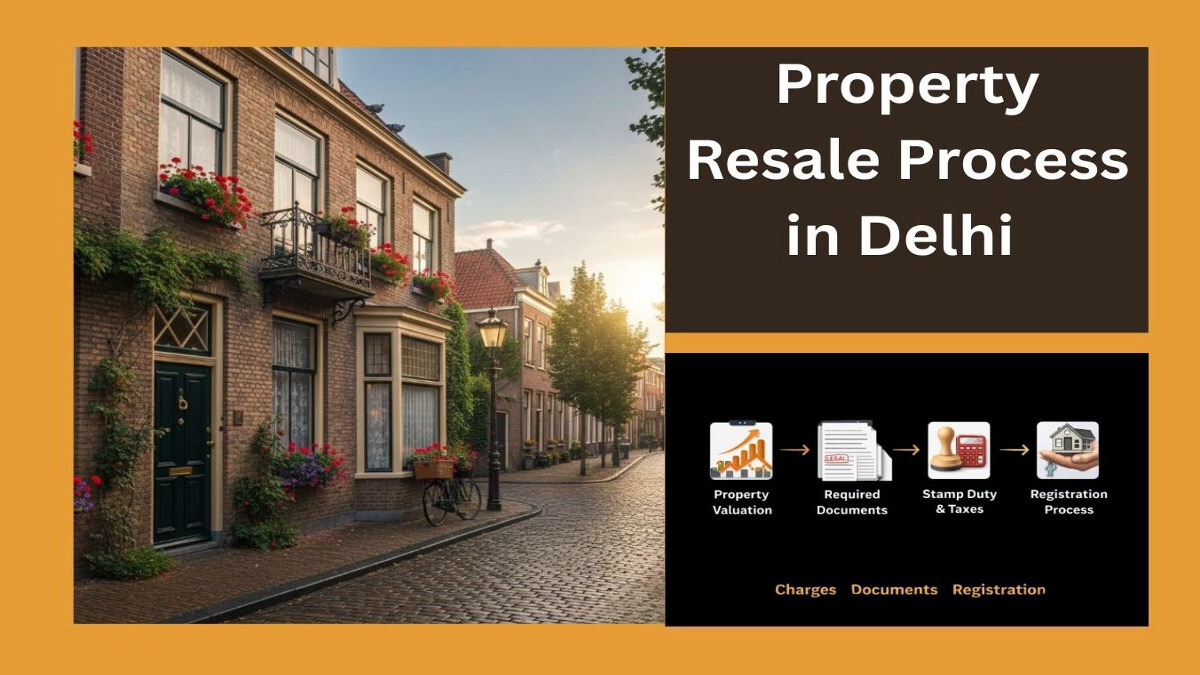
Property Resale Process in Delhi: The Complete 2026 Buyer's Guide
Buying a resale property in Delhi is not for the faint-hearted. It is a chaotic mix of history, bureaucracy, and aggressive negotiation. Unlike buying a new apartment in a shiny Noida tower where the builder handles the paperwork, buying a "used" home in Delhi means you are on your own. You are dealing with individual sellers, centuries-old land records, and multiple authorities like DDA, MCD, and L&DO.
I have seen deals collapse at the Sub-Registrar's office because of a single missing page in a 20-year-old deed. I have seen families lose their life savings buying "Lal Dora" land that looked cheap but was legally worthless. This guide is not legal theory. It is a practical, street-smart roadmap for buying a resale home in Delhi—from South Delhi builder floors to DDA flats in Rohini—without getting scammed.
1. The "Chain of Documents": The Backbone of Your Deal
In the resale market, the current owner's Sale Deed is just the tip of the iceberg. What matters is the "Chain".
What is the Chain?
Imagine the property was first allotted by DDA to Mr. Singh in 1985. Mr. Singh sold it to Mrs. Gupta in 1995. Mrs. Gupta sold it to Mr. Khan in 2010. Now Mr. Khan is selling it to you.
You need the Original documents for EVERY step of this journey:
- The original DDA Allotment Letter (1985).
- The Sale Deed between Singh and Gupta (1995).
- The Sale Deed between Gupta and Khan (2010).
The Reality Check: Sellers often say, "Oh, the 1995 deed is lost, but I have a photocopy." Walk away. Banks will not give a home loan on a photocopy. If a document is genuinely lost, there must be an FIR and a public notice from that year. Without the original chain, you don't own the property; you just occupy it.
2. Freehold vs. Leasehold: The DDA Complication
Delhi is unique because a huge chunk of it was built by the Delhi Development Authority (DDA) on Leasehold land.
The Leasehold Trap
In a Leasehold property, the government owns the land, and the resident owns the structure for 99 years. You cannot sell this easily. You need DDA's permission, and you have to pay "Unearned Increase" charges (which can be lakhs).
The Freehold Solution
Most properties today are converted to Freehold. This gives you absolute ownership of the land. Before you pay a single rupee of token money, ask the seller for the Conveyance Deed. This is the certificate that proves the property is Freehold. If they don't have it, ask them to get it converted first. Do not take on that headache yourself.
3. Types of Properties in Delhi (And Their Risks)
Delhi is not uniform. The rules change depending on what you are buying.
DDA Flats (Rohini, Dwarka, Janakpuri)
These are the safest bet legally. The paperwork is standard. However, check for illegal alterations. If the owner has extended a balcony or built an extra room on the terrace, the MCD can demolish it, or the bank will reject your loan valuation.
Builder Floors (The Modern Craze)
This is where old houses are demolished to build 4-story floors.
The Risk: Parking. In most colonies like Lajpat Nagar or Rajouri Garden, parking is a war zone. Ensure your Sale Deed specifically mentions your designated parking spot. "Common parking" means "No parking".
Co-operative Group Housing Societies (CGHS)
Common in Patparganj and Dwarka.
The Risk: The Managing Committee. You need a "No Dues Certificate" from the society. Some societies have insane transfer charges (hidden as "Donation" or "Welfare Fund") ranging from ₹50,000 to ₹5 Lakhs. Clarify who pays this—you or the seller—before signing.
Lal Dora Land (The "Village" Areas)
These are old village lands (like parts of Hauz Khas Village or Munirka) exempt from building bye-laws.
The Verdict: Avoid. They rarely have clear titles, banks won't lend on them, and you can't register a Sale Deed easily.
4. The Hidden Costs: Budgeting Beyond the Price
If you agree to buy a flat for ₹1 Crore, you will end up spending ₹1.08 Crores. Here is the math nobody tells you.
| Expense Head |
Cost Estimate |
Reality |
| Stamp Duty |
4% (Women) / 6% (Men) |
Register in your wife/mother's name to save 2%. That is ₹2 Lakhs on a ₹1 Cr property! |
| Registration Fee |
1% of Value |
Mandatory. No discounts here. |
| Brokerage |
1% - 2% |
Negotiable. But good brokers (who check papers) deserve their 1%. |
| Transfer Charges |
₹50k - ₹5 Lakhs |
Only for Societies/CGHS. A major hidden shock. |
| Legal Verification |
₹15,000 |
Do not skip this. It is cheaper than a lawsuit. |
5. The Broker Factor: Friend or Foe?
In Delhi, you cannot avoid property dealers. They control the inventory. But you must know how to handle them.
The Commission Rule
The standard brokerage in Delhi is 1% of the deal value from the Buyer and 1% from the Seller. GST (18%) is applicable if they are a registered company.
Negotiation Tip: If the deal is above ₹2 Crores, you can negotiate the brokerage down to 0.75% or a fixed lump sum. But do not squeeze them too hard; a motivated broker fights for your price reduction with the seller.
The "Net Deal" Scam
Some brokers will propose a "Net Deal". They say, "The seller wants ₹1 Crore net. Anything above that is mine."
Avoid this. It encourages the broker to inflate the price. Always insist on a "Commission Basis" deal where you pay the seller directly and the broker separately. Transparency is non-negotiable.
6. The Step-by-Step Buying Process (The Safe Way)
Follow this order. Do not deviate.
Step 1: The Token (Bayana)
You like the house. You pay a "Token" (usually ₹50,000 to ₹1 Lakh) to freeze the price.
Rule: Never pay cash. Pay by Cheque/UPI. If the deal fails, you need a bank trail to recover this money.
Step 2: Agreement to Sell (ATS)
This is the detailed contract. You usually pay 10% of the property value now.
Critical Clause: Ensure there is a "Defective Title Clause". It should say: "If the seller's title is found defective during legal search, the seller must refund the entire amount with interest within 7 days." Without this, your money is stuck.
Step 3: The Public Notice
Your lawyer should publish a notice in two newspapers (one English, one Hindi) stating that you are buying this property. This invites objections. If a long-lost brother or a creditor has a claim on the property, they have to speak up now. If no one objects in 7-14 days, you are safer.
Step 4: The Home Loan (The Ultimate Check)
Even if you have the cash, take a small home loan. Why? Because banks have ruthless legal teams. They will dig up dirt on the property that your lawyer might miss. If a bank like SBI or HDFC refuses to fund the property, treat it as a giant red flag and run.
Step 5: The Registration Day
You go to the Sub-Registrar's Office (SRO). It will be crowded. You will wait.
The Payment: You hand over the remaining payment (Demand Drafts) to the seller ONLY in front of the Sub-Registrar. Do not give it outside.
Biometrics: Your fingerprints and photos are taken. The Sale Deed is signed.
7. TDS @ 1%: The Trap for Buyers
If the property is worth ₹50 Lakhs or more, the Income Tax department makes YOU (the buyer) responsible for collecting tax. You must deduct 1% of the total sale value and deposit it with the government (Form 26QB).
The Mistake: Buyers pay the full amount to the seller and forget TDS. Result? You get a notice to pay that 1% from your own pocket later, plus interest. The seller will not pick up your phone then.
8. After the Sale: Mutation and Utilities
Getting the keys is not the end.
MCD Mutation: You must update your name in the Municipal Corporation of Delhi (MCD) records. This ensures property tax bills come in your name. Without mutation, you cannot sell the property later.
Utilities: Transfer the Electricity Meter (BSES/Tata Power) and Delhi Jal Board water connection immediately. You will need the Sale Deed and a "No Dues Certificate" from the previous owner.
Conclusion
Buying a home in Delhi is a battle, but it is a battle worth winning. The capital appreciation in established colonies like Vasant Kunj or the connectivity in places like Lajpat Nagar is unmatched. The key is to be paranoid about paperwork. Trust no one, verify everything, and never pay cash for things that should be on paper. If you follow this process, that dream home in the capital will be a blessing, not a burden.
Need to move in? Don't break your back. Check our guide on Packers and Movers in Delhi. Planning to rent it out instead? Make sure your Rental Agreement is solid.
Frequently Asked Questions (FAQs)
Is it safe to buy a property on Power of Attorney (GPA) in Delhi?
Absolutely not. The Supreme Court banned GPA sales in 2011. A GPA does not give you ownership title. You can live there, but you can't legally sell it, and the original owner can revoke the GPA anytime. Always insist on a registered Sale Deed.
What is the "Circle Rate" and why does it matter?
The Circle Rate is the minimum price per sq. meter set by the Delhi Government for property registration. You cannot register a sale below this price. If the market price is lower than the Circle Rate (rare, but happens), you still have to pay Stamp Duty on the Circle Rate value.
Can I pay the Stamp Duty in cash at the SRO?
No. The days of cash are over. Stamp Duty in Delhi must be paid online through the Stock Holding Corporation of India (e-Stamping). You generate a certificate and attach it to your Sale Deed before going to the office.
How do I know if the property is mortgaged?
This is tricky. The best way is to visit the CERSAI website. It is a central registry where banks file equitable mortgages. A search there can reveal if the property is pledged to a bank. Also, ask for the original previous deed—banks keep the original when they give a loan.
What is the "Conversion Charge" for mixed-use properties?
If you are buying a ground floor property in a residential area that is used for a shop or office, ensure the "Conversion Charges" have been paid to the MCD. If not, the shop can be sealed, and you will be liable for huge penalties.