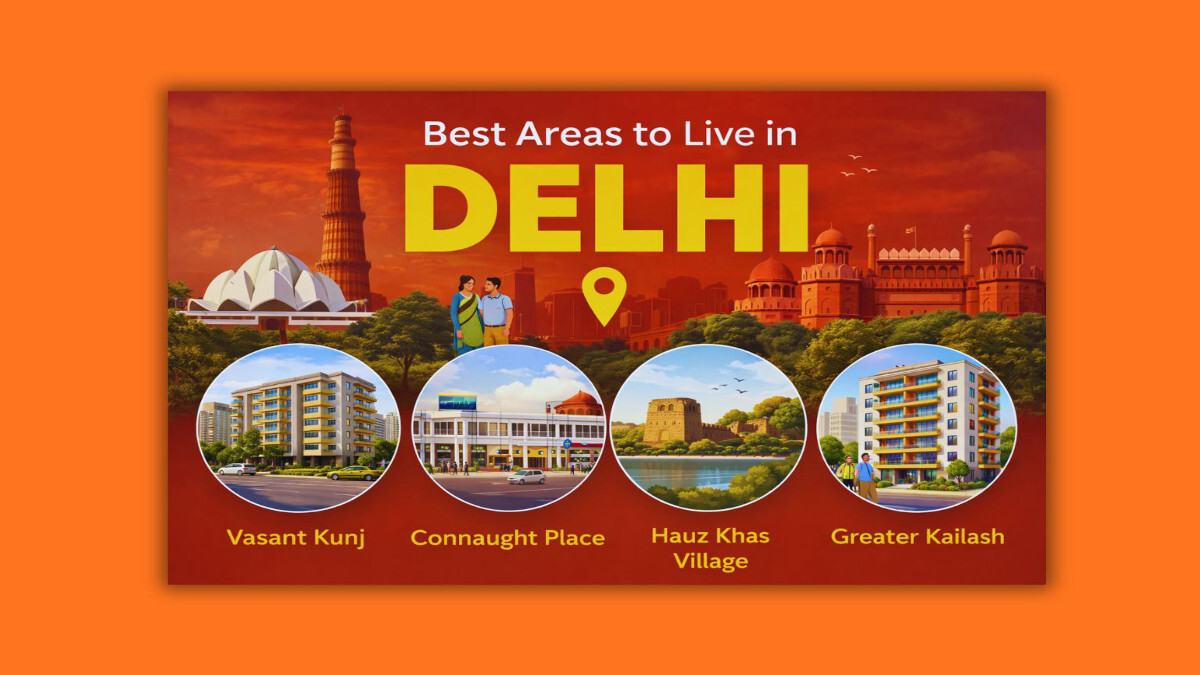
Best Areas to Live in Delhi: 2026 Reality Check Guide
Moving to Delhi is a lifestyle shock. It isn't one city—it's seven chaotic cities pretending to be one. South Delhi mimics a leafy European suburb (ignoring the honking), while West Delhi feels like an endless Punjabi wedding. Then there's Dwarka: a utopian grid from afar, but a concrete island when the metro stops.
Stop looking for the "Best Area"—it doesn't exist. There is only the "Best Area for Your Commute and Budget." With the 2026 Metro network and legendary Ashram traffic jams, your location determines your mental health. This guide navigates the chaos.
This guide isn't a property brochure. We won't sell you "lush green surroundings." We cover water supply, parking wars, landlord attitudes, and the real vibe. Whether you are a student, corporate slave, or family, here is the unfiltered reality check.
1. South Delhi: The "Status Symbol" Trap
South Delhi is where "Old Money" lives and "New Money" tries to break in. It has two distinct worlds.
The Elite Tier: Greater Kailash (GK), Defence Colony, Vasant Vihar
Addresses here scream status.
- The Vibe: Wide roads, parks, and markets selling avocados and imported cheese. Quiet, green, and expensive.
- The Rent: Brutal. A 2BHK floor starts at ₹60,000 up to ₹1.5 Lakh. Security deposits are often two months' rent.
- The Reality Check:
1. Parking is Hell: Built for the Fiat era, these colonies now struggle with 3-SUV families. Expect daily parking battles.
2. Water Tankers: Even in Vasant Vihar, the rich rely on private tankers in summer. "Posh" doesn't guarantee 24/7 supply.
3. Landlords: Intrusive. Living on the ground floor, they often monitor guests and delivery packages.
The "Affordable" South: Saket, Malviya Nagar, Lajpat Nagar
This is the practical South Delhi. It is younger, louder, and more accessible. It’s where the real action happens.
- The Vibe: Saket is the sweet spot. You have the malls (Select Citywalk), the PVR Anupam complex, and the Yellow Line Metro. Malviya Nagar is a bit more congested but has a great food scene (hello, Champa Gali). Lajpat Nagar is the shopping capital.
- The Rent: High but manageable. A 1BHK/RK can be found for ₹20,000 - ₹25,000. A 2BHK is around ₹35,000 - ₹45,000.
- The Reality Check:
1. Congestion: These are old colonies. The internal lanes are narrow. If you have a big car, good luck turning it around in Malviya Nagar.
2. The "Builder Floor" Maze: Most buildings are 4-story builder floors with no lift. If you live on the 3rd floor, you are doing cardio every day.
3. Metro Connectivity: Excellent. The Yellow Line connects you to Gurgaon (Cyber Hub) in 30 minutes and CP in 25 minutes. This is why rents stay high here.
2. Dwarka: The Organized Concrete Jungle
Dwarka is Asia's largest sub-city. If South Delhi is chaotic organic growth, Dwarka is planned grid perfection. But it has a soul of its own.
The Sector Logic
Dwarka is divided into Sectors. The lower numbers (Sector 4, 5, 6, 10, 11, 12) are the "Prime" areas with bustling markets and main markets. The higher numbers (Sector 19, 21, 23) are quieter, closer to the airport, but feel a bit isolated.
- The Vibe: Wide roads, proper footpaths, and Societies. Unlike South Delhi's independent floors, Dwarka is 90% High-Rise Apartments (CGHS - Cooperative Group Housing Societies). It feels more like a modern city.
- The Rent: Value for money. You can get a spacious 3BHK in a society with a guard and lift for ₹35,000. In South Delhi, that gets you a garage.
- The Reality Check:
1. Water Quality: This is the elephant in the room. Dwarka ground water is salty. Most societies rely on RO plants, but hair fall is a common complaint here. Ask about the water source (DJB vs. Tanker vs. Boring) before signing.
2. The Isolation: Dwarka is self-contained. You have schools, hospitals, and malls within Dwarka. But if your friends live in Noida or South Delhi, you will never see them. It is a trek.
3. Safety at Night: While the societies are safe, the wide stretches of road between sectors can feel deserted and unsafe after 10 PM. It is not a "walking city" at night.
3. Central Delhi: The UPSC & Commercial Hub (Karol Bagh, Rajendra Nagar)
This is the heart of Delhi, but it beats with a very specific rhythm—the rhythm of competitive exams and wholesale markets.
Old Rajendra Nagar & Karol Bagh
If you see a young person with a backpack looking stressed, they are probably preparing for the IAS exam here.
- The Vibe: Intense. The streets are lined with coaching centers, bookshops, and libraries. It is not a place to relax; it is a place to hustle. Karol Bagh market is chaotic but has everything from electronics to wedding clothes.
- The Rent: Surprisingly high for the quality. A tiny 1RK (room kitchen) can cost ₹18,000 because demand from students is massive.
- The Reality Check:
1. Basement Hazards: After recent crackdowns, basement libraries and gyms are strictly regulated. Avoid living in or using illegal basement setups.
2. Crowded Living: You will likely live in a building packed with students. It is noisy, and privacy is a myth.
3. Connectivity: The Blue Line Metro makes it very easy to reach CP or Noida.
4. West Delhi: Punjabi Bagh, Rajouri Garden, Janakpuri
Welcome to the land of big cars and bigger weddings. West Delhi is loud, flashy, and fun.
The Vibe
Close-knit and community-driven. Rajouri Garden and Punjabi Bagh are fashion runways. Food is incredible—butter chicken is a staple here.
- The Rent: Janakpuri is the most balanced option. It is green, well-connected by the Blue Line, and has a mix of floors and DDA flats. Rent for a 2BHK is ₹25,000 - ₹35,000. Punjabi Bagh is elite territory, comparable to South Delhi prices.
- The Reality Check:
1. Noise: If you love silence, this is not for you. Traffic noise, religious processions, and late-night parties are standard features.
2. Parking: In areas like Rajouri, parking on the street is a combat sport. Make sure your rental includes a designated parking spot.
3. Connectivity: The Blue Line and Pink Line have revolutionized West Delhi. You can reach South Delhi or Noida easily now.
5. North Delhi: The Student Republic
North Campus (Delhi University) defines this area. It is young, intellectual, and runs on caffeine and instant noodles.
GTB Nagar, Hudson Lane, Kamla Nagar
- The Vibe: It feels like a permanent college festival. Hudson Lane is lined with cafes. The streets are full of students with backpacks.
- The Rent: It works on a "Per Bed" basis. A single room can cost ₹12,000 - ₹15,000. A shared flat is cheaper but cramped.
- The Reality Check:
1. Landlord Policing: Since most tenants are students, landlords act like wardens. "No opposite gender guests" is the first rule in the agreement.
2. Broker Mafia: The broker network here is aggressive. They dominate the market. Finding a place without a broker is nearly impossible.
3. Congestion: Kamla Nagar is a traffic bottleneck. Do not bring a car here. A scooty is the maximum vehicle size allowed by physics in these lanes.
6. East Delhi: The Affordable Chaos (Mayur Vihar, Laxmi Nagar)
East Delhi is often looked down upon by South Delhi snobs, but it is the lifeline for the middle class and Noida commuters.
Mayur Vihar Phase 1 & 2
This is the "Gem of the East." It is clean, has great DDA pockets, and is right on the border of Noida.
- The Vibe: Retired government officers, journalists, and families. It is safe and has a strong community feel.
- The Rent: Very reasonable. A 2BHK DDA flat can be rented for ₹22,000 - ₹28,000.
- The Reality Check:
1. The "Jamna Paar" Label: Ignore the stigma. Mayur Vihar is better connected to Central Delhi (via Barapullah) than most of West Delhi.
2. Old Construction: Most DDA flats are old. Check for seepage and plumbing issues before moving in.
Laxmi Nagar
The hub of CA aspirants and UPSC students.
- The Reality: It is suffocatingly crowded. Buildings are constructed with zero gaps. Sunlight is a luxury. But it is cheap (₹10,000 for a 1BHK) and has the Blue Line Metro. Only live here if budget is your absolute #1 priority.
7. Noida & Gurgaon: The "NCR" Option
Technically not Delhi, but half the city works here. Gurgaon (Cyber City) is for those working there—rents are sky-high (₹50k+ for 2BHK) but offer luxury high-rises. Noida (Sector 7x) offers bigger houses for less money (3BHK for South Delhi 1BHK prices), but the peak-hour commute to Delhi is painful.
8. Cost of Living: 2026 Estimates
Delhi is not cheap, but it's flexible. Here is a realistic monthly breakdown (excluding rent):
- Electricity: ₹0 to ₹3,000 (Use the Electricity Bill Name Change process for subsidy).
- Maid/Cook: ₹3,000 - ₹6,000 (Cleaning + cooking).
- Groceries: ₹6,000 - ₹10,000 (Depends on shopping habits).
- Commute (Metro): ₹1,500 - ₹2,500 (Fastest and cheapest option).
- Internet/Wifi: ₹600 - ₹1,000.
9. The "Bachelor" Discrimination Reality
We need to talk about this. Delhi landlords have a hierarchy of preference:
- Vegetarian Family (God Tier)
- Non-Veg Family (Acceptable)
- Single Working Women (Monitored closely)
- Single Working Men (Suspicious)
- Lawyers/Police/Journalists (Avoided like the plague)
If you are a bachelor, look for areas like Saket (J Block), Lajpat Nagar 4, or Mukherjee Nagar where landlords are used to tenants. In strict family societies (like Patparganj or Dwarka), you might face "RWA Interviews" where uncles ask you about your drinking habits and marriage plans. Lie if you have to. Say you work 12 hours a day and go to sleep at 9 PM. Also, ensure you have a proper Rent Agreement that protects your rights against sudden eviction.
Conclusion: The "15-Minute Rule"
In the end, the best area in Delhi is the one that is 15 minutes from your office or the nearest Metro station. Delhi is too big and the traffic is too unpredictable to prioritize "status" over "commute." Don't fall for the trap of living in a posh area if it means spending 3 hours a day in a cab.
If you prioritize nightlife, pick South Delhi. If you prioritize space and family safety, pick Dwarka or Mayur Vihar. If you prioritize saving money, pick West or East Delhi. But always, ALWAYS check the water pressure and phone signal strength inside the flat before paying the token money. Those are the two things no broker will tell you about. Once you finalize a place, don't forget the mandatory Police Verification to avoid legal hassles.
Frequently Asked Questions (FAQs)
Q: Which is the safest area for a single woman in Delhi?
A: South Delhi (GK, Safdarjung, Saket) and Dwarka (gated societies) are top picks. Areas with active markets and movement until late night are safer than secluded posh colonies. Always check if the streetlights work in the lane leading to your house.
Q: What is the average security deposit in Delhi?
A: It is strictly one or two months. In Gurgaon, landlords ask for 2-3 months, but in Delhi, if someone asks for 3 months, they are scamming you. Stick to the 1-2 month norm.
Q: Is it better to live in a Society or a Builder Floor?
A: Societies (Dwarka/Noida) offer security, power backup, and plumbers on call. Builder Floors (South/West Delhi) offer privacy and better location but you are on your own for water motors and security. For families, Societies win. For bachelors, Builder Floors offer more freedom. If buying a DDA flat, check if it is Freehold or Leasehold.
Q: How much does electricity cost in Delhi?
A: Here is the magic: Up to 200 units is FREE in Delhi (as of 2026). Up to 400 units is subsidized. This is a huge saving compared to Gurgaon or Noida where you pay commercial rates for power backup. Also, ensure the bill is transferred correctly using the Electricity Bill Name Change process.
Q: Can I get a rent agreement if I don't have a permanent Delhi address?
A: Yes. You only need your Aadhaar (from anywhere in India) and PAN card. The landlord provides the electricity bill as proof of the property address. Police verification is mandatory and happens online now.