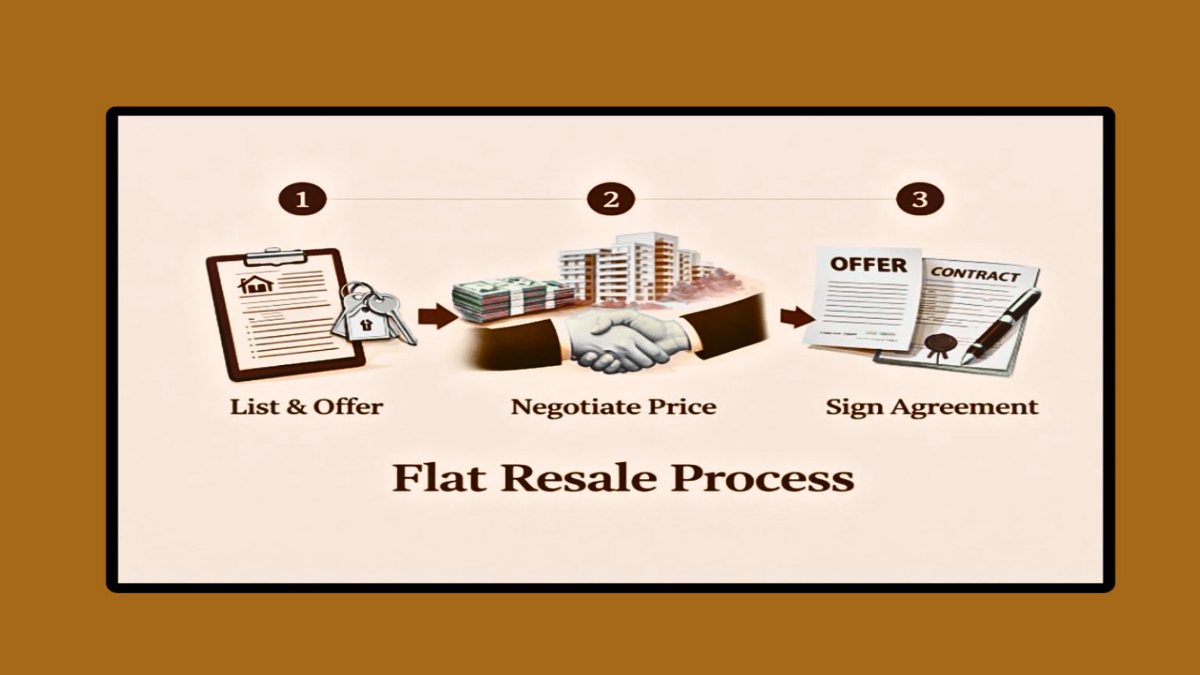
Flat Resale Process in Mumbai – Legal Checklist (2026 Guide)
Buying a resale flat in Mumbai is like navigating a minefield. Unlike a new launch where you deal with a corporate developer, a resale deal involves a random individual seller, a cooperative housing society (CHS) with its own ego, and a "Chain of Documents" that might date back to the 1980s. One missing paper, one unpaid society bill, or one vague clause in the 1995 agreement, and your dream home becomes a legal nightmare.
Yet, resale flats are often the best investment. You get more carpet area (older buildings had bigger rooms), you see exactly what you are buying (no "sample flat" tricks), and you get possession immediately. The risk is high, but the reward is higher—if you follow the rules.
This guide is your Legal Checklist. We are not talking about Vastu or interior design here. We are talking about the hard legal steps—from the "Token Money" to the "Share Certificate Transfer"—that ensure you actually own the flat you paid for. This is the 100% real, street-smart process for Mumbai resale deals in 2026.
Step 1: The "Search Report" (The Foundation)
Before you pay even ₹1 as a token, ask for the property papers. You need to conduct a Title Search.
The "30-Year" Rule
A lawyer will go to the Sub-Registrar's office and check the records for the last 30 years. They are looking for:
- Flow of Title: Did A sell to B? Did B sell to C? Is there a missing link? If B sold to C, but the agreement is not registered, C technically doesn't own it.
- Encumbrances: Is there a pending mortgage? Has the flat been attached by a court order?
- Litigation (Lis Pendens): Is there a family dispute? In Mumbai, it is common for a brother or sister to pop up claiming a share in the property after the father's death.
Reality Check: Don't rely on the "Bank's Search Report". Banks only care if the property is mortgageable. They don't care if the society has a water leakage issue or if the neighbor is suing the owner. Hire your own independent property lawyer.
Step 2: The "Token Money" & MOU
Once you like the flat, the broker will pressure you: "Sir, another party is coming with a cheque." Don't panic.
The "Token" Rule
Never pay more than ₹1 Lakh to ₹2 Lakhs as the initial token. This is "Goodwill Money" to stop showing the flat to others. If you pay 10% upfront without paperwork, you are at the seller's mercy.
The MOU (Memorandum of Understanding)
Instead of a direct Agreement to Sale, sign an MOU first. This document lists the Terms & Conditions:
- Price & Payment Schedule: When will you pay the rest?
- Refund Clause: CRITICAL. Add a clause saying: "If my Home Loan is rejected by the bank for any technical reason related to the property, the seller must refund the token money in full within 7 days." Without this, the seller can forfeit your token if the deal fails.
- TDS Responsibility: Who will deduct the 1% TDS? (Usually you, the buyer).
Step 3: The Society NOC (The Gatekeeper)
In Mumbai, the Cooperative Housing Society (CHS) is powerful. You cannot buy a flat without their blessing.
The "No Objection Certificate" (NOC)
The seller must apply for an NOC. The society checks if the seller has any unpaid maintenance dues or illegal alterations (like enclosing a balcony). If there are dues, the seller must clear them before the NOC is issued.
The "Transfer Fee" Scandal
Legally, under the Maharashtra Cooperative Societies Act, the Transfer Premium is capped at ₹25,000.
The Reality: Many societies in posh areas (Bandra, Juhu) demand a "Voluntary Donation" of ₹1 Lakh to ₹5 Lakhs to the society repair fund. They won't give the NOC unless you pay.
The Fix: You can fight it legally, but it will delay your deal. Most buyers negotiate (e.g., split 50-50 with the seller). Don't try to quote the Bylaws to the Chairman; he will just sit on your file for months. Treat it as a "Peace Tax".
Step 4: The "Chain of Documents" (The Mumbai Nightmare)
We mentioned this in the Search Report, but let's go deeper. The Registrar (SRO) will demand the Original Chain of Agreements.
Scenario: You are buying from Mr. Sharma.
Mr. Sharma bought from Mr. Patil in 2010.
Mr. Patil bought from the Builder in 2000.
You need:
- Original Registered Agreement of 2000 (Builder -> Patil).
- Original Registered Agreement of 2010 (Patil -> Sharma).
- Share Certificate (Original).
What if an Original Document is Lost?
If Mr. Sharma says, "I lost the 2000 agreement," you have a problem.
The Solution: He must file a Police FIR for the lost document and publish a public notice in two newspapers. Then, you need to get a "Certified Copy" of the lost deed from the SRO. Banks might still hesitate to fund this. Proceed with extreme caution.
Step 5: Valuation & Home Loan
If you are taking a loan, the bank will send a technical valuer.
The Trap: You agreed to buy the flat for ₹2 Crores. The Bank Valuer visits and says, "The building is old, the carpet area is less, the market value is only ₹1.5 Crores."
The Bank funds 80% of ₹1.5 Cr (i.e., ₹1.2 Cr), not 80% of ₹2 Cr.
Result: You suddenly need to arrange an extra ₹40 Lakhs from your own pocket.
Advice: Get a "Pre-Valuation" done if you are stretching your budget.
Step 6: Stamp Duty & Registration
This is the day you officially become the owner. (Read our detailed Registration Process Guide for the logistics).
For Resale, the Stamp Duty is calculated on the Higher of:
In South Mumbai, RR rates are often higher than market rates. You might pay tax on ₹5 Cr even if you bought it for ₹4 Cr.
TDS (Tax Deducted at Source)
If the deal value is ₹50 Lakhs or more, you (Buyer) must deduct 1% TDS from the payment to the seller. This is linked to the seller's Capital Gains Tax liability.
Example: Deal is ₹1 Crore. You pay ₹99 Lakhs to the Seller and ₹1 Lakh to the Income Tax Department (Form 26QB).
Warning: If you forget this, YOU (the buyer) will get a notice from the IT department with interest and penalty. The seller won't care.
Step 7: Possession & Handover
Registration is done. The bank has released the cheque to the seller. Now you get the keys. But wait.
The "Utility Transfer" Checklist
- Electricity Meter: Check the last bill. Has it been paid? You need to transfer the meter to your name (Adani/Tata Power/MSEDCL).
- Piped Gas (MGL): Transferring the gas connection requires an NOC from the seller and a small fee.
- Property Tax: Check if the seller has paid the BMC Property Tax. In many old buildings, property tax arrears run into Lakhs.
Step 8: The Final Mutation (Share Certificate)
You have the Registered Sale Deed. Now you go back to the Society.
Submit the:
- Copy of Registered Sale Deed.
- Copy of Index II.
- Transfer Forms (usually Form 20 and 21).
- Transfer Fee (₹25,000 cheque).
- Membership Fee (₹500).
The Society Committee will pass a resolution in the next meeting and
endorse your name on the back of the Share Certificate.
Congratulations! Now you are the legal member of the society.
Common Mistakes to Avoid
1. Ignoring the "Adjudication": If the previous owner bought the flat in 1995 on a ₹100 stamp paper, that deed is "Under-Stamped". You cannot register your new deed until the old duty is paid with penalty. This is called Adjudication. It takes months.
2. Paying Cash for "Furniture": Sellers often ask for 20% in cash saying "This is for furniture/amenities" to save tax. This is Black Money. If the deal goes bad, you cannot prove you paid this amount.
3. Not Checking Parking Rights: In Mumbai, parking is war. Does the flat come with a "Stilt Parking" mentioned in the agreement? Or is it an "Open Parking" allotted by the society? Open parking is not owned; it is a society right. If the seller says "I own this open spot," he is lying.
Final Advice: Trust, but Verify
A resale flat is a relationship with the seller. You need them to sign papers, give NOCs, and hand over keys. Be polite, but be legally ruthless. Don't accept "Chalta Hai" (It's okay) excuses for missing documents. A lawyer's fee of ₹15,000 can save you from a loss of ₹1.5 Crores. Follow this checklist, and your Mumbai home journey will be safe.
Frequently Asked Questions (FAQs)
Q1: Can I buy a flat if the Original Share Certificate is lost?
It is risky. The seller must first apply to the society for a "Duplicate Share Certificate" by following the due process (FIR, Public Notice, Indemnity Bond). Do not buy until the Duplicate Certificate is physically issued by the society.
Q2: Who pays the Transfer Premium of ₹25,000?
Legally, it can be paid by either party or shared. Usually, in Mumbai market practice, the Buyer pays the Transfer Fee and the Donation, while the Seller pays for the NOC dues.
Q3: Is the "Chain of Agreements" needed for a building constructed in 1980?
Yes. Ideally, you need the chain for the last 30 years. If the 1980 agreement is missing, you need to rely on the Share Certificate and Property Tax receipts, but banks may reject the loan. A "Title Search Report" is mandatory here.
Q4: What is the "Deemed Conveyance" issue?
Many societies in Mumbai don't own the land; the Builder still owns it. Check if the Society has "Conveyance" or "Deemed Conveyance" in its favor. If not, redevelopment will be stuck later, affecting your future value.
Q5: Can I get a loan for the "Stamp Duty" amount?
No. Banks only fund the "Agreement Value" (Basic Cost). Stamp Duty, Registration, GST, and Transfer Fees must be paid from your own pocket (Self Contribution).
Disclaimer: Real estate laws in Maharashtra are subject to change. This guide is for informational purposes only. Please consult a qualified property lawyer before signing any legal documents.