Mumbai Rental Agreement Process: Online Registration, Charges & Rules (2026 Guide)
In Mumbai, renting a flat is like running a marathon. You fight traffic to see the flat, fight brokers over commission, and finally, you have to fight the paperwork. The "Rental Agreement" (officially called the Leave and License Agreement) is the most critical document protecting you from disputes.
Gone are the days of ₹100 stamp paper agreements notarized by a lawyer on the street corner. In Mumbai, Registered Agreements are mandatory for Housing Society NOCs and Police Verification. If you are moving to Andheri, Bandra, or even Thane, this guide covers the 100% legal way to rent in 2026.
1. Leave and License vs. Lease: Know the Difference
First, understand what you are signing. In Mumbai's residential market, we strictly use "Leave and License", not "Lease".
Leave and License (The Standard)
Under the Maharashtra Rent Control Act, 1999, this is the safest option for landlords and tenants.
- Nature: You (Licensee) are given permission to occupy the flat for a temporary period. You do NOT get any ownership rights or "tenancy rights".
- Eviction: The law favors the owner if the tenant refuses to vacate after the agreement expires. The Competent Authority can order eviction quickly.
- Period: Usually 11 months to 33 months (3 years).
Lease Agreement (The Risk)
A Lease creates an "interest" in the property. Eviction is extremely difficult under civil law. No sensible landlord in Mumbai will sign a Lease Deed for a residential flat because tenants can claim "Protected Tenant" status after long occupancy.
Myth Buster: "I can only rent for 11 months."
False. You can make a Leave and License agreement for 24 months, 36 months, or even 60 months (5 years). The "11-month" cycle is just a habit to renew terms and increase rent annually.
2. Cost Calculation: Stamp Duty & Registration Charges
Unlike property purchase (where Stamp Duty is 5-6%), rental stamp duty is cheap, but it is mandatory. For a detailed breakdown of property taxes, check our Stamp Duty Guide.
The Formula
Stamp Duty: 0.25% of the Total Taxable Value.
Taxable Value Calculation:
(Monthly Rent × Number of Months) + (Non-Refundable Deposit) + (10% of Refundable Deposit per year).
Example:
Rent: ₹30,000 | Deposit: ₹1,00,000 | Tenure: 12 Months.
Total Rent = ₹3.6 Lakhs.
10% of Deposit = ₹10,000.
Taxable Value = ₹3.7 Lakhs.
Stamp Duty = 0.25% of ₹3.7 Lakhs = ₹925.
Registration Fee
- Municipal Corporation Limits (Mumbai, Thane, Navi Mumbai, Pune): Fixed at ₹1,000.
- Rural Areas: ₹500.
Who Pays?
Legally, the Licensor (Owner) and Licensee (Tenant) can share it. However, in Mumbai's market practice, the Licensee (Tenant) usually bears the full cost of Stamp Duty and Registration. The Owner usually just signs.
3. The Online Registration Process (E-Registration)
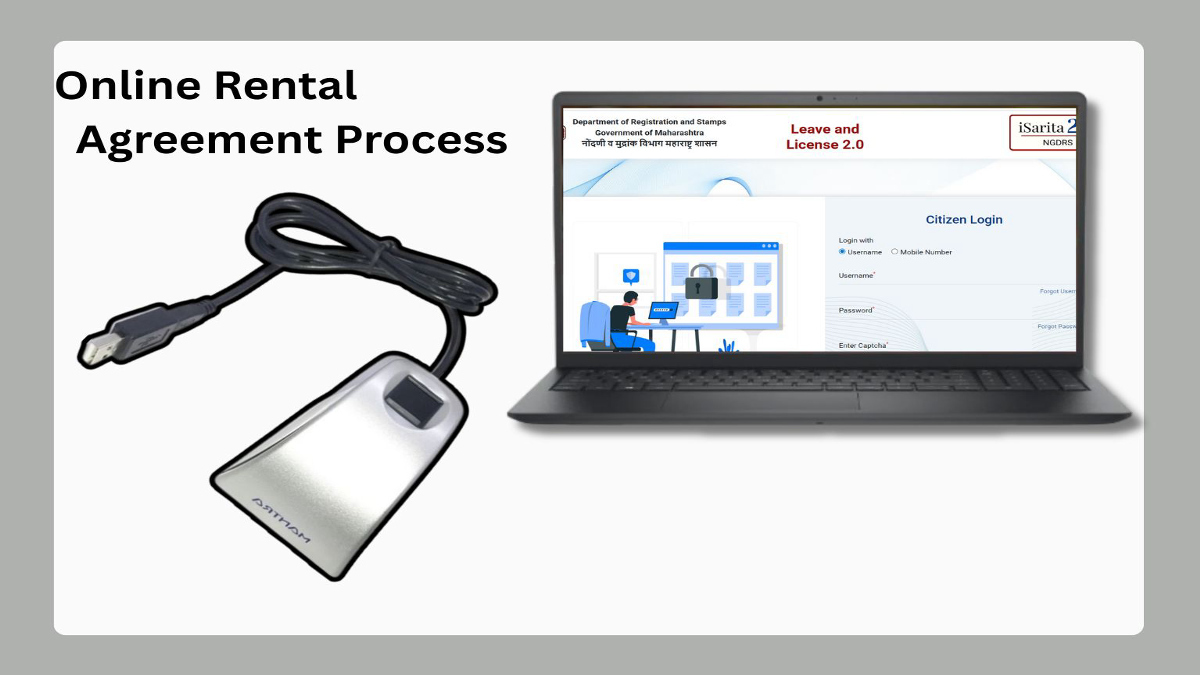
You do not need to visit the crowded Sub-Registrar's Office (SRO) anymore. The Maharashtra Government has a fantastic E-Registration portal. This is different from the physical Property Registration process required for buying flats.
Prerequisites
- Aadhaar Card: Owner, Tenant, and 2 Witnesses MUST have Aadhaar cards.
- Mobile Linked to Aadhaar: Essential for OTP verification. If your number isn't linked, you cannot do E-Registration.
- Biometric Device: A thumb scanner connected to a computer.
The Process (Step-by-Step)
- Drafting: The agent fills in the details (Rent, Deposit, Clauses, Furniture List) on the government portal.
- Payment: Stamp Duty and Registration fees are paid online via GRAS (Government Receipt Accounting System).
- Photos & Thumbs: The Owner and Tenant give their thumb impressions (captured via device) and photos (via webcam).
- Witnesses: Two witnesses (friends/brokers) also provide Aadhaar + Thumb impression.
- Submission: The data is uploaded to the server.
- Approval: The Sub-Registrar verifies the data remotely.
- Final PDF: The Registered Agreement is generated with a digital signature and sent via email (usually takes 24-48 hours).
The "Doorstep" Service: You don't need to buy a biometric device. Agents charge ₹500 to ₹1,000 (service fee) to bring the laptop and scanner to your home or office. It is worth every rupee to avoid the SRO office queue.
4. The "Bachelor" Struggle: Society NOC
If you are a single man or woman in Mumbai, you know the pain. Many Cooperative Housing Societies (CHS) have unwritten rules banning "bachelors".
Is this legal?
Technically, no. But Societies hide behind "majority resolution" rules. If they refuse to give an NOC (No Objection Certificate), you cannot move in.
The Workaround:
1. Police Verification is Key: Show them the police verification receipt first. It calms their fears about "security".
2. Family Co-Signer: Sometimes, having a parent sign the agreement as a "Co-Licensee" satisfies the committee.
5. Police Verification: The Mandatory Safety Check
In Mumbai, renting a flat without Police Verification is a punishable offense for the landlord (under Section 188 of IPC).
How to do it?
Online Method (Mumbai Police):
1. Go to the Mumbai Police "Tenant Information" website.
2. Upload Tenant's Photo and ID Proof.
3. Upload Owner's Details.
4. Submit and get a PDF Acknowledgement.
Offline Method:
Download the form, fill it, paste photos, and submit it to the local police station. They will stamp the "Received" copy.
Note: The society will NOT give the NOC (No Objection Certificate) for moving in unless you show the Registered Agreement and the Police Verification copy.
6. Critical Clauses Checklist (Don't Get Cheated)
The standard government draft is basic. You must add "Custom Clauses" in the Annexure for safety. Ensure these are present:
| Clause |
Why it matters |
| Lock-in Period |
If you leave early, you lose deposit. If owner cancels early, they pay penalty. usually 6 months. |
| Furniture Inventory |
List every item (AC remote, keys, fans). Take photos. Avoids "You stole the fan" accusations. |
| Painting Rule |
Who paints when you leave? Standard: Tenant pays for Deep Cleaning, Owner pays for Painting. |
| Non-Occupancy Charges |
Societies charge 10% extra for rented flats. Clarify who pays this (Owner usually). |
| Force Majeure |
If building collapses or floods (like 2005/2026), rent should stop immediately. |
7. The "Heavy Deposit" (Pagdi) Model
In older parts of Mumbai (Dadar, Sion, Thane Old City), you might hear of the "Heavy Deposit" system.
How it works:
Instead of paying ₹25,000 rent, you pay a huge interest-free deposit (e.g., ₹20 Lakhs) to the landlord.
Rent: Nominal (₹1,000 or zero).
Benefit: The interest on ₹20 Lakhs (at 7% FD rate = ₹1.4 Lakhs/year) acts as the rent for the landlord. You get the full ₹20 Lakhs back when you leave.
Risk: If the landlord goes bankrupt or refuses to return the money, you are in big trouble. Always register this agreement and ensure the cheque numbers are mentioned in the document.
8. Brokerage Rules in Mumbai
The unwritten rule of Mumbai Real Estate:
- Amount: 1 Month's Rent.
- Who Pays? BOTH. The Owner pays 1 month, and the Tenant pays 1 month.
- Renewal Brokerage: Some greedy brokers ask for brokerage every year upon renewal. Refuse this. Standard practice is brokerage only on the first agreement. For renewals, you can pay a small "Paperwork Fee" (₹2k-₹5k) but not full brokerage.
9. Rights & Duties (Tenant vs. Owner)
Tenant Rights
- Privacy: The landlord cannot enter the flat without 24 hours' notice.
- Receipts: You have the right to receive rent receipts (needed for HRA tax exemption).
- Essential Services: The landlord cannot cut off water or electricity to force eviction.
Owner Rights
- Inspection: Right to inspect the property (with notice) to check for damages.
- Eviction: Right to evict if rent is unpaid for 3 months or if the tenant conducts illegal activities.
- Deposit Deduction: Right to deduct money for actual damages (broken tiles, burnt switches) but not for normal wear and tear.
Frequently Asked Questions (FAQs)
Q1: Is a Notarized Agreement valid in Mumbai?
NO. For Leave and License, only a Registered Agreement is valid in court. Notarized agreements are useless for Police Verification or Passport Address Proof. Don't save ₹1,000 and risk your legal safety.
Q2: Can the Society reject a tenant?
Legally, NO. Societies cannot discriminate based on religion, caste, or food habits (veg/non-veg). However, they can reject "Bachelor Tenants" if their bylaws explicitly state so (though this is legally contestable, it's a common practice in Mumbai).
Q3: What if the Owner doesn't return the Deposit?
If you have a Registered Agreement, you can file a complaint with the Competent Authority. The law allows you to stay in the flat without paying rent until the deposit is refunded (check your specific agreement clause for this).
Q4: Who pays for major repairs?
The Owner. Structural repairs, leakage from outside, and electrical wiring faults are the Owner's responsibility. The Tenant only pays for minor repairs (fused bulbs, leaking taps) and damages caused by their negligence.
Disclaimer: This guide outlines the general process in Mumbai. Legal rules can change. Always consult a certified property lawyer or registered agent for your specific agreement drafting.