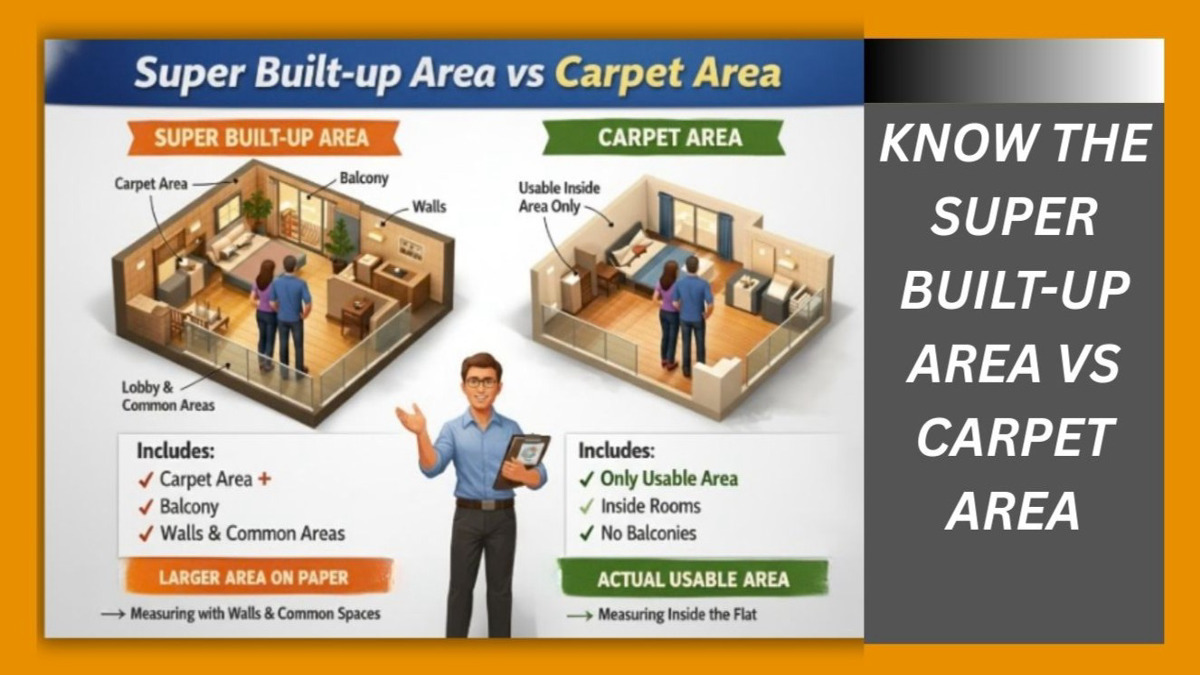
Super Built-up Area vs Carpet Area: Don't Pay for Air (2026 Guide)
Imagine buying a 1kg box of sweets, but when you open it, there are only 600 grams of sweets and 400 grams of "packaging weight". You would feel cheated, right?
Welcome to Indian Real Estate. This is exactly what happens when you buy a flat based on Super Built-up Area (SBU). You pay for 1,000 sq.ft., but you can only live in 600 sq.ft. The rest? You are paying for the lobby, the staircase, the lift shaft, the clubhouse you might never use, and yes, even the watchman's cabin.
In 2026, despite strict RERA regulations, the "Loading Factor" scam is alive and kicking. Builders have stopped legally selling on Super Built-up Area because RERA forbids it, but they still use it to manipulate your psychology during the site visit. They quote a "Saleable Area" to make the per-square-foot rate look cheap, while the actual usable space shrinks every year.
This guide is not a textbook definition. It is a street-smart manual to help you distinguish between what you pay for and what you actually get. We will decode the math, expose the "Flower Bed" traps, and show you how to measure your flat using nothing but floor tiles.
1. The Three Magical Areas (Simple Definitions)
Forget the engineering textbooks. Here is what these terms mean for your wallet:
A. Carpet Area (The Real Deal)
This is the area where you can literally lay a carpet. It includes your bedrooms, hall, kitchen, and bathrooms.
RERA Definition: The net usable floor area of an apartment, excluding the area covered by external walls, but including the area covered by internal partition walls.
Think of this as: The space where you live, sleep, and eat.
B. Built-up Area (The Walls)
This is Carpet Area + Thickness of Inner/Outer Walls + Dry Balcony.
Usually, Built-up Area is 10-15% more than Carpet Area. You can't live in the walls, but you have to pay for building them.
C. Super Built-up Area (The Marketing Gimmick)
This is Built-up Area + Common Areas (Lobby, Lift, Staircase, Clubhouse, Gym, Swimming Pool, Garden, Generator Room).
Also known as "Saleable Area". This is the inflated number builders use to make the "Per Sq.Ft Rate" look attractive. If a builder says the rate is ₹5,000/sq.ft, he is usually quoting on this inflated area.
2. The "Loading Factor" Scam Explained
Loading Factor is the percentage of "air" added to your carpet area to arrive at the Super Built-up Area. It is the gap between what you pay for and what you get.
- Old Buildings (Pre-2000): Loading was low (15-20%). A 1,000 sq.ft flat had roughly 800 sq.ft of carpet area. These flats feel huge today.
- New Towers (2026): Loading is insane (35-60%). A 1,000 sq.ft "Saleable" flat might have only 580 sq.ft of carpet area. You are paying for "Lifestyle Amenities" that eat into your private space.
The Math Trap (Don't Be Fooled):
Scenario A: Builder quotes ₹8,000/sq.ft on Super Built-up (1200 sq.ft). Total Cost = ₹96 Lakhs.
Scenario B: Builder quotes ₹13,000/sq.ft on RERA Carpet Area (700 sq.ft). Total Cost = ₹91 Lakhs.
The Illusion: You think Scenario A is cheaper because ₹8,000 sounds better than ₹13,000.
The Reality: Scenario B is actually cheaper by ₹5 Lakhs! Plus, you know exactly what you are getting. Always calculate the "Ticket Size" (Final Package Cost), not the per sq.ft rate.
3. The "Efficiency Ratio" Test (Do This Math)
Before you book a flat, calculate the Efficiency Ratio. This tells you how much of your money is going into your home vs. the common areas.
Formula: (RERA Carpet Area / Super Built-up Area) * 100
- Above 75%: Excellent (Rare in new buildings, common in Mhada/Government schemes).
- 65% - 75%: Good (Standard for decent standalone buildings).
- 60% - 65%: Average (Common in large townships with many amenities).
- Below 60%: Daylight Robbery. You are paying too much for "Air". If a 1000 sq.ft saleable flat has less than 600 sq.ft carpet, walk away.
4. The "Flower Bed" & "Service Slab" Trap
In cities like Pune and Mumbai, builders use architectural tricks to cheat the FSI (Floor Space Index) norms.
The "Flower Bed" Scam
Builders show a "Flower Bed" or "Planter" space attached to the window. They tell you, "Sir, you can grill this later and take it inside to make the room bigger."
The Risk: This is illegal. If the municipal corporation (PMC/BMC) cracks down, they will demolish that extension. You cannot legally count this as Carpet Area. Do not pay the full square foot rate for this space.
The "Service Slab" Trick
Some builders provide a "Service Slab" outside the bathroom for AC units but show it as part of the "Usable Deck". Again, this is not habitable space. Be very careful when a sales guy points to empty air and says "This is all yours."
5. RERA Rules: What Changed?
Before 2017 (RERA), it was the Wild West. Builders sold "1,200 sq.ft" flats that were actually tiny coops. There was no standard definition of a square foot.
The Law Now (2026):
1. Builders MUST quote price on RERA Carpet Area only.
2. In the registered agreement, the exact Carpet Area must be mentioned.
3. If the actual carpet area is less than promised during possession, the builder must refund the money with interest.
The Loophole: While the Agreement strictly says Carpet, the Brochure, Hoardings, and Sales Guy still talk in "Saleable Area" to satisfy the buyer's ego. "Sir, it is 650 carpet, but the lifestyle space is 1100." Don't fall for the "Lifestyle" jargon. You can't sleep in the lifestyle.
6. The Balcony & Terrace Confusion
In Pune and Mumbai, balconies are gold dust. But are they Carpet?
- Enclosed Balcony: If it is legally sanctioned as part of the room, it is Carpet.
- Open Balcony / Deck: RERA counts this separately as "Verandah/Balcony Area". It is NOT part of the standard Carpet Area definition but is usable. Ensure this area is mentioned separately in your agreement.
- Terrace: Usually sold at 50% of the carpet rate. Ensure it is legally yours and not "Common Society Space" given to you exclusively (which is illegal). A private terrace must be mentioned in the Index-2 document.
7. How to Measure It Yourself (The Tile Method)
Don't trust the brochure blindly. Brochures often include the width of the walls in the room dimensions. When you visit a sample flat or a ready flat, measure it yourself.
Method A: The Laser Check
Buy a Laser Distance Measure (₹1,500 on Amazon). Measure wall-to-wall in every room. Calculate Length x Breadth. It takes 10 minutes and saves you Lakhs.
Method B: The "Tile Count" Hack (Street Smart)
If you don't have a tape, look at the floor tiles.
Most modern flats use 2ft x 2ft (Vitrified) or 4ft x 2ft (GVT) tiles.
Count the tiles: If a room is 5 tiles wide and 6 tiles long (using 2x2 tiles), the room is roughly 10ft x 12ft = 120 sq.ft.
This gives you an instant reality check. If the brochure says the bedroom is 14ft x 12ft but you only see 10ft worth of tiles, something is wrong.
8. The Hidden Cost: Maintenance Charges
The "Super Built-up" scam doesn't end at purchase. It haunts you every month in your maintenance bill.
The Scenario:
Your Society charges ₹4 per sq.ft for maintenance.
The Trap: They usually charge on the Super Built-up Area (1000 sq.ft), not your Carpet Area (600 sq.ft).
The Cost: You pay ₹4,000/month.
The Reality: For your actual 600 sq.ft home, you are effectively paying ₹6.66 per sq.ft! Over 10 years, this extra "phantom" maintenance adds up to Lakhs. Always check the society's billing logic before buying.
9. Old vs New Buildings (The Resale Advantage)
This is why resale flats in older areas like Kothrud (Pune) or Ghatkopar (Mumbai) are in high demand.
- Old Flats (15-20 years old): Low loading. A 2 BHK of 1000 sq.ft SBU usually has 850 sq.ft Carpet. You get massive rooms.
- New Flats: High loading. A 2 BHK of 1000 sq.ft SBU has 600 sq.ft Carpet. You get a "Compact" home.
Advice: If space is your priority, look for a well-maintained resale society. You might miss out on a swimming pool, but you will get a bedroom where a King-size bed actually fits.
10. Why "Zero Loading" is a Myth
You might see ads screaming: "Zero Loading! Pay for what you get!"
Reality Check: No builder builds the lobby, lift, and terrace for free. Construction costs money. If they claim "Zero Loading", they have simply increased the per sq.ft rate of the carpet area to cover the construction cost of common areas.
Example: Instead of selling at ₹5,000 on SBU (with 40% loading), they sell at ₹8,500 on Carpet (with 0% loading). The final price is the same. The money comes from your pocket, one way or another.
Conclusion: Buy the Space, Not the Number
At the end of the day, you live in the Carpet Area. Your furniture fits in the Carpet Area. Your family laughs and fights in the Carpet Area. The Super Built-up Area is just a number on a brochure.
When comparing two projects, ignore the "Saleable Area" completely. Ask one simple question:
"What is the exact RERA Carpet Area and what is the Final All-Inclusive Package Cost?"
Divide the Cost by the Carpet Area. That is your real price per square foot. Everything else is just marketing gas.
Frequently Asked Questions (FAQs)
Q1: Is Carpet Area same as RERA Carpet Area?
Not exactly. Traditional Carpet Area didn't include internal walls. RERA Carpet Area includes the thickness of internal partition walls. So, RERA Carpet is slightly larger than the old-school net carpet definition. It is the legal standard now.
Q2: What is a "Good" Loading Factor in 2026?
In a luxury high-rise with gym, pool, and huge lobbies, 45-50% loading is standard. In a standalone building with just a lift and staircase, loading should not exceed 25-30%. Anything above 60% is a warning sign of poor efficiency.
Q3: Do I pay maintenance on Carpet or Super Built-up?
Crucial Point: Most societies charge maintenance on Square Feet. If they charge on Super Built-up, you pay more. RERA recommends charging on Carpet Area, but many old societies still use the "Bill per sq.ft Saleable" method. Clarify this with the RWA.
Q4: Can I sue the builder for less carpet area?
Yes. Under RERA, if the actual carpet area is less than the agreement area (by more than 3%), the builder MUST refund the excess amount paid with interest. He cannot hide behind "approximate" clauses anymore.
Q5: Is the Dry Balcony included in RERA Carpet?
No. RERA mandates showing "Carpet Area", "Exclusive Balcony Area", and "Exclusive Verandah/Service Area" separately. Make sure you check the breakup in the agreement to avoid surprises.
Disclaimer: Real estate area definitions are governed by RERA rules. Always refer to the official RERA website of your state (MahaRERA/GujRERA) for project-specific carpet area details before booking.